
PlayHT has long been a popular choice for text-to-speech and voice cloning, but it certainly isn’t the only capable player in the AI voice space anymore. Whether you’re a podcaster, YouTuber, e-learning developer, or indie game studio, the right voice tool depends heavily on your budget, language needs, and how much control you want over tone and emotion. In this guide, we’ve rounded up 12 of the strongest PlayHT Alternatives available today, covering everything from budget-friendly hobbyist tools to enterprise-grade voice platforms. For each one, we break down their free trial availability, current pricing plans straight from their official websites, key strengths, and a few honest drawbacks so you can make a confident, well-informed choice for your next project.
Quick Navigation
1. Fliki
Visit Website

Free Forever Plan – No Card Required
Standard: ~$21/mo (annual)
Premium: ~$66/mo (annual)
Enterprise: Custom
Fliki doesn’t offer a traditional trial since its Free plan works as one indefinitely, giving you 3 credits monthly with 720p exports and a watermark. Paid tiers, according to Fliki’s official pricing page, start with Standard at roughly $21/month billed annually, and Premium at around $66/month, unlocking 1080p exports, longer videos, and voice cloning.
Beyond pricing, Fliki stands out as a script-to-video platform that pairs AI voiceovers with automatic visuals, stock footage, and captions. It supports over 2,000 voices across 80+ languages, making it especially useful for creators who want to turn blog posts, PowerPoints, or simple text prompts into finished videos without touching a separate editor.
Pros
- Free plan usable indefinitely with no credit card
- Combines voiceover generation with full video creation
- Huge voice and language library
- Simple idea-to-video and blog-to-video workflows
Cons
- Free tier exports carry a watermark
- Only stock visuals; no AI-generated scenes
- Commercial use requires a paid plan
- Credit system can be confusing for new users
2. WellSaid Labs
Visit Website
Free Trial – No Card Required
Starter: $19/mo ($10/mo annual)
Pro: $49/mo ($33/mo annual)
Business: $160/mo/user
Enterprise: Custom
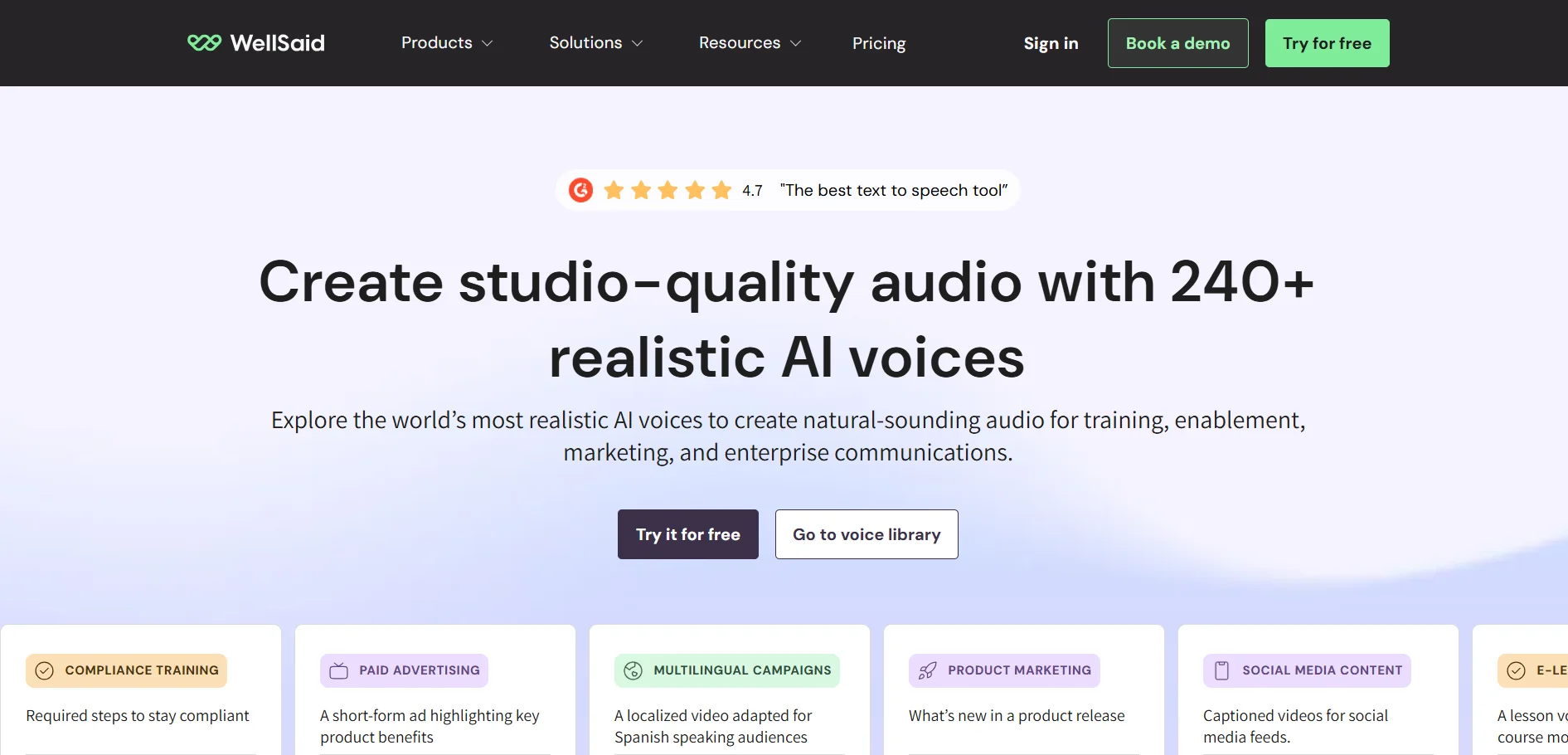
WellSaid Labs offers a genuinely free trial tier with 3 download minutes monthly and no card requirement, per its official pricing page. Paid plans begin with Starter at $19/month (or $10/month billed annually), then Pro at $49/month ($33/month annually), and scale to Business at $160 per user monthly, with Enterprise pricing custom-quoted for larger teams.
What sets WellSaid apart is its studio-quality voice avatars built from real, consenting voice actors, aimed squarely at corporate training, marketing, and internal communications teams. It offers unlimited generation and retakes on paid plans, Adobe Premiere and Express integrations, and SOC 2 Type 2 compliance that appeals heavily to enterprise buyers.
Pros
- Exceptionally natural, studio-recorded voice avatars
- Unlimited audio generation and retakes on paid tiers
- SOC 2 Type 2 and GDPR compliant infrastructure
- Strong Adobe Premiere and Express integrations
Cons
- Free trial limited to just 3 minutes monthly
- Business plan pricing is per-seat and can add up fast
- Limited voice cloning compared to newer rivals
- Fewer non-English voices than competitors
3. Uberduck
Visit Website

Free Tier Available
Starter: $2/mo (annual)
Creator: $5/mo (annual)
Pro: $30/mo (annual)
Uberduck’s official pricing page lists a free tier for exploration, followed by Starter at just $2/month for non-commercial use with 1,000 monthly credits. The Creator plan runs $5/month with 3,600 credits and commercial licensing, while Pro jumps to $30/month for 25,000 credits, API access, and 24-hour support response times, all discounted 20% when billed yearly.
Uberduck built its reputation on playful, expressive features that most competitors skip entirely, including AI-generated rap vocals and singing, alongside over 5,000 voices for standard text-to-speech. It’s particularly popular with Discord communities, meme creators, and musicians experimenting with AI-assisted tracks rather than polished corporate narration.
Pros
- Extremely affordable entry-level pricing
- Unique AI rap and singing generation
- Massive voice library exceeding 5,000 options
- Developer-friendly API for custom integrations
Cons
- Voice naturalness trails premium competitors
- Celebrity voice library has shrunk due to legal pressure
- Commercial licensing on cloned voices remains murky
- Occasional server errors reported by users
4. iSpeech
Visit Website

Free Basic Plan
Plus: $2.95/mo ($19.95/yr)
Premium: $3.95/mo ($29.95/yr)
iSpeech offers a permanently free Basic plan alongside two budget-friendly paid tiers, according to its official policies page. The Plus plan costs $2.95 monthly or $19.95 yearly and supports up to 30-minute recordings, while Premium costs $3.95 monthly or $29.95 yearly, extending recording length to a generous 12 hours per conversion.
As one of the longest-running text-to-speech providers, iSpeech focuses on simplicity and developer accessibility rather than flashy features, offering a straightforward API, browser toolbars, and reliable cloud infrastructure. It’s a solid pick for accessibility tools, basic voiceovers, and lightweight applications that don’t need advanced emotional voice control.
Pros
- One of the cheapest paid tiers in the industry
- Simple, developer-friendly API access
- Long-standing, reliable service history
- Generous recording length on Premium
Cons
- Voice quality feels dated next to newer AI models
- Limited voice cloning and emotional range
- Interface looks noticeably less modern
- Fewer premium voice styles overall
5. Supertone Play
Visit Website
Free Plan – No Card Required
Starter: $2.99/mo
Creator: $14.99/mo
Pro: $79.99/mo
Enterprise: Custom
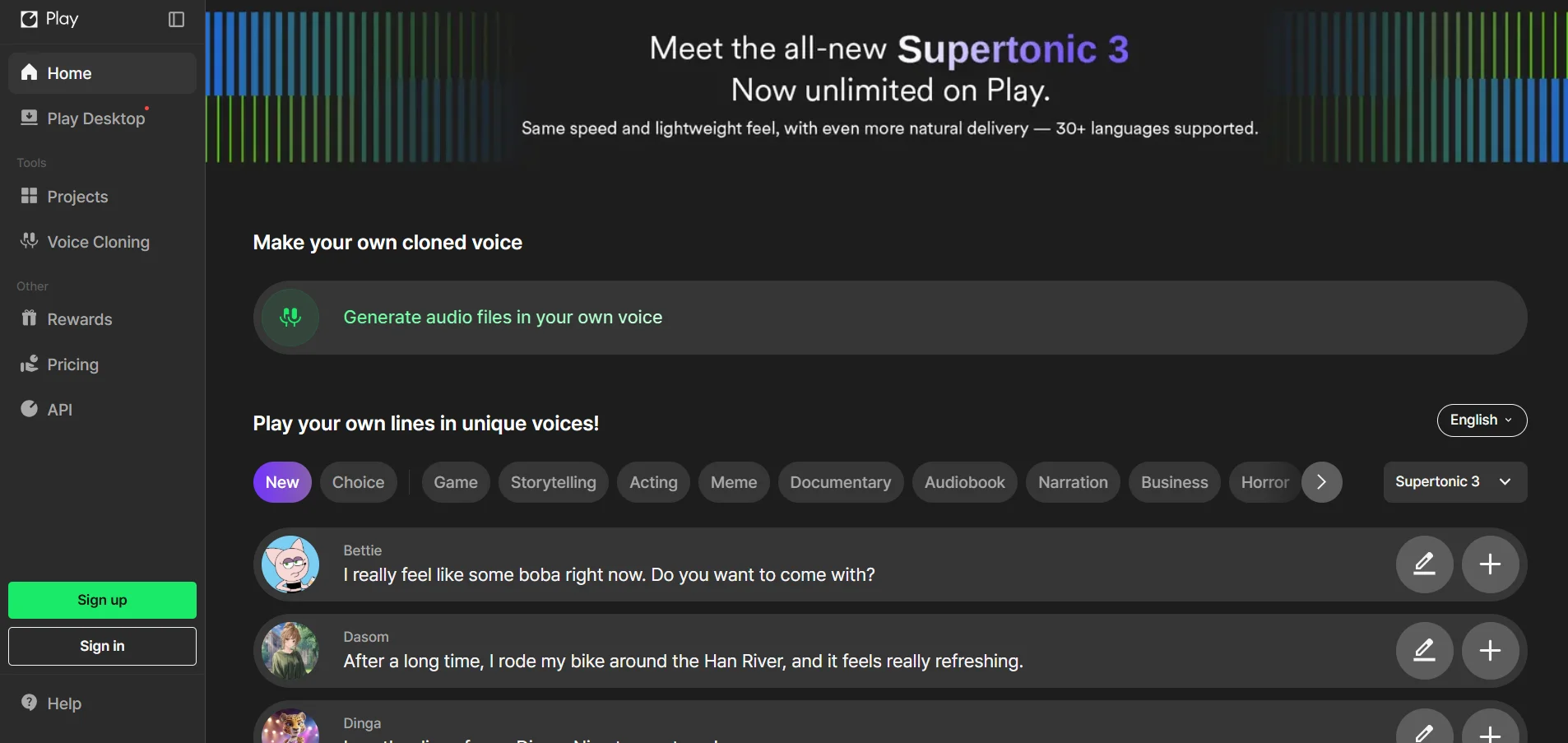
Supertone Play, developed by HYBE’s AI subsidiary, offers a genuinely usable free plan with 3,000 monthly credits and no card required, confirmed directly on its official pricing page. Starter costs $2.99/month for 20,000 credits, Creator runs $14.99/month with 100,000 credits, and Pro reaches $79.99/month for 500,000 credits plus unlimited desktop app usage.
Supertone Play differentiates itself with genuinely expressive character voices, unlimited voice cloning even on the free tier, and support for 23 languages through its Sona 2 model. Its non-verbal expression tags, like inserting natural laughter, make it especially appealing for storytelling, audiobooks, and game character voice work.
Pros
- Unlimited voice cloning available even on the free tier
- Highly expressive, emotionally nuanced voices
- Commercial use permitted with attribution on free plan
- Supports 23 languages via the Sona 2 model
Cons
- Best language support concentrated in Korean, English, Japanese
- Credits do not roll over between billing cycles
- Free tier requires attribution for commercial use
- Pro tier pricing jumps steeply from Creator
6. KikiVoice
Visit Website

Completely Free – No Sign-up
Premium: Higher limits, priced on request
KikiVoice positions itself as a free, browser-based voice cloning tool that requires no sign-up or credit card to start, based on its official website. Free users get weekly auto-resetting credits for conversions, and while premium plans with higher character limits and priority processing exist, current published sources don’t list fixed public tier pricing.
KikiVoice’s core appeal is speed and accessibility: upload a 3 to 15 second voice sample and get a clone in minutes, using one of three models—Core, Pro, or Multilingual—for over 75 languages. It’s ideal for quick experiments, podcast intros, and social content rather than large-scale production pipelines.
Pros
- No registration or credit card needed to start
- Fast, near-instant voice cloning from short samples
- Supports 75+ languages and accents
- Three model options for different use cases
Cons
- No public API currently available
- Character limits per conversion are fairly restrictive
- Pricing for premium tiers isn’t clearly published
- Weekly credit resets limit heavier workflows
7. Cartesia
Visit Website
Free Tier – No Card Required
Pro: ~$5/mo
Startup: ~$39/mo
Scale: ~$239/mo (annual)
Enterprise: Custom
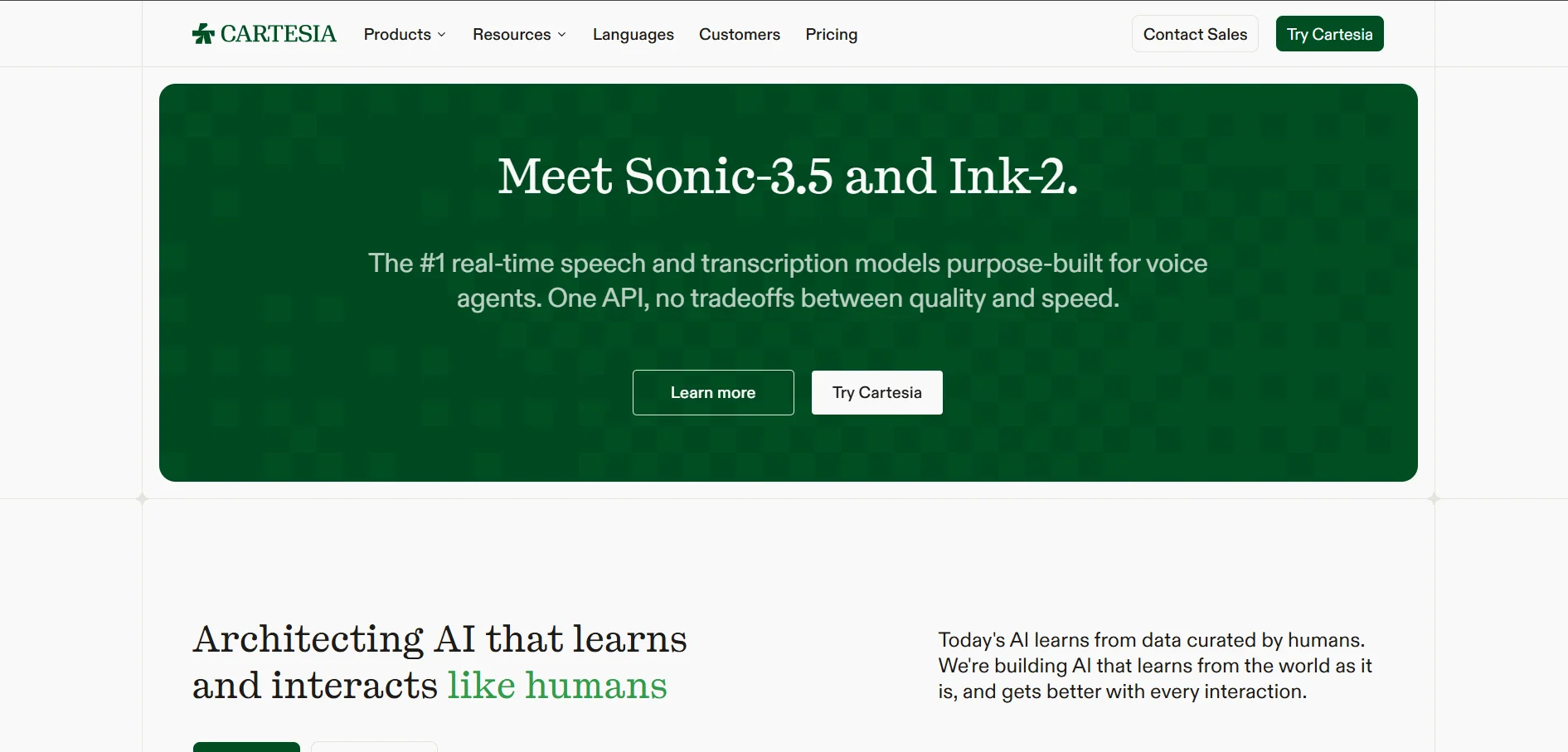
Cartesia’s free plan includes 20,000 model credits monthly and $1 of prepaid voice-agent usage with no upfront commitment, according to its official pricing page. Pro costs roughly $5/month with 100,000 credits and instant voice cloning, Startup runs around $39/month, and Scale reaches $239/month annually, dropping telephony rates significantly for high-volume users.
Cartesia is built around real-time, low-latency voice AI, powering its Sonic text-to-speech model, Ink speech-to-text, and Line voice-agent platform. It’s a favorite among developers building conversational AI products like call center bots and voice assistants that need sub-second response times rather than pre-recorded voiceover work.
Pros
- Industry-leading low latency for real-time voice
- Affordable entry point for commercial voice cloning
- Combines TTS, speech-to-text, and voice agents in one platform
- Scales well for developers building production apps
Cons
- Credit-based pricing can be hard to estimate upfront
- Free tier disallows commercial use
- Higher tiers require annual billing for best rates
- More developer-oriented than creator-friendly
8. Podcastle
Visit Website
7-Day Free Trial + Free Plan
Storyteller: $11.99/mo (annual)
Pro: $23.99/mo (annual)
Business: $64.99/mo
Enterprise: Custom
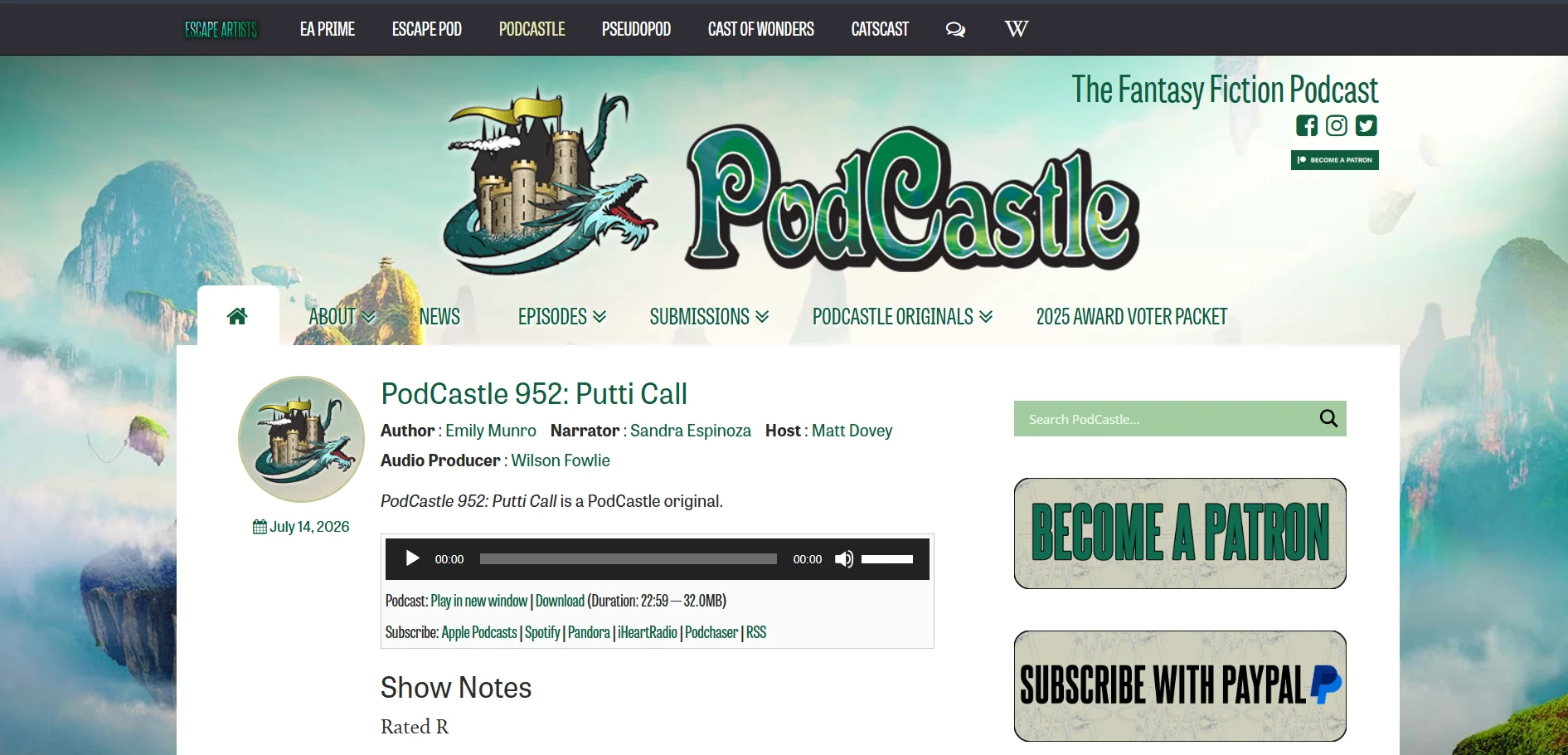
Podcastle, now also branded Async, offers a free plan with unlimited audio recording plus a 7-day free trial of premium features, per its official pricing information. Storyteller costs $11.99/month billed annually, Pro reaches $23.99/month, Business is $64.99/month for team collaboration, and Enterprise pricing is custom-quoted for larger organizations.
Podcastle combines studio-quality remote recording, AI editing tools like Magic Dust noise removal, and Revoice voice cloning into one unified platform. It’s best suited to podcasters and video creators who want recording, editing, transcription, and AI voiceover generation without juggling several separate apps.
Pros
- All-in-one recording, editing, and voiceover platform
- Free plan supports unlimited audio recording
- Revoice voice cloning available on Pro tier
- Built-in hosting and podcast distribution
Cons
- Free plan video recording capped at 3 hours lifetime
- Voice cloning locked behind the Pro plan
- Team collaboration requires the pricier Business tier
- Recent rebrand to Async has caused some user confusion
9. Murf.AI
Visit Website
Free Plan Available
Creator: $19/mo (annual)
Business: $66/mo (annual)
Enterprise: Custom
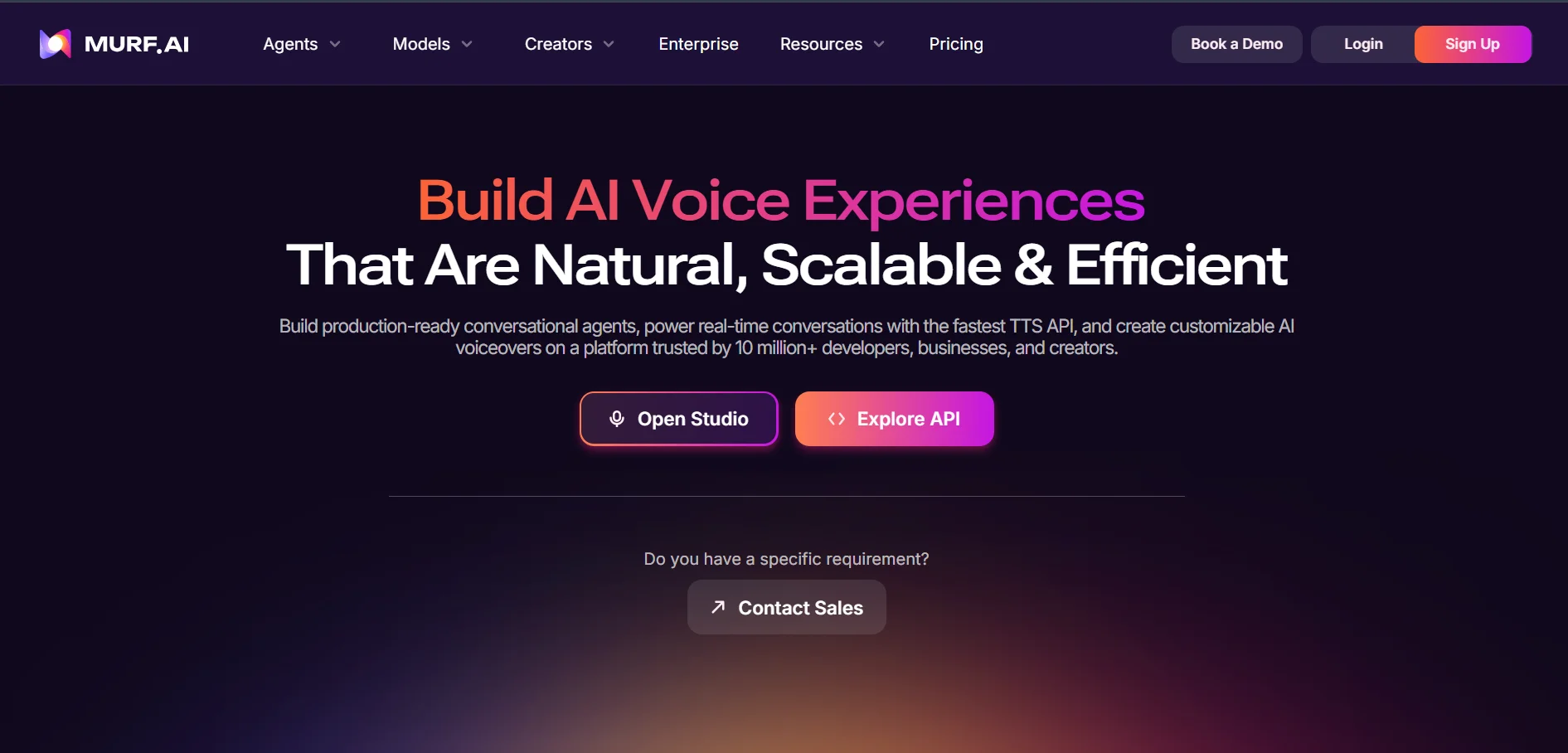
Murf.AI’s official pricing page lists a Free plan offering 10 minutes of voice generation with no commercial rights or downloads. Creator jumps to $19/month billed annually (or $29 monthly), adding commercial rights and 24 hours of yearly generation, while Business runs $66/month annually with 96 yearly hours, and Enterprise pricing is custom.
Murf is best known for its polished browser-based editor featuring a timeline, pitch and emphasis controls, and integrations with Canva and PowerPoint. It supports video dubbing across 25+ languages and offers separate API pricing for developers, making it a strong choice for e-learning and marketing teams alike.
Pros
- Polished, professional-grade editing interface
- Strong Canva and PowerPoint integrations
- Video dubbing across 25+ languages
- ISO 42001 certified for AI management
Cons
- Free plan blocks all commercial usage
- Unused generation minutes don’t roll over
- API pricing is billed entirely separately
- Enterprise costs can balloon with add-ons
10. Voice.ai
Visit Website
Free Tier Available
Starter: $5/mo
Launch: ~$12/mo (intro)
Core: $99/mo
Enterprise: Custom
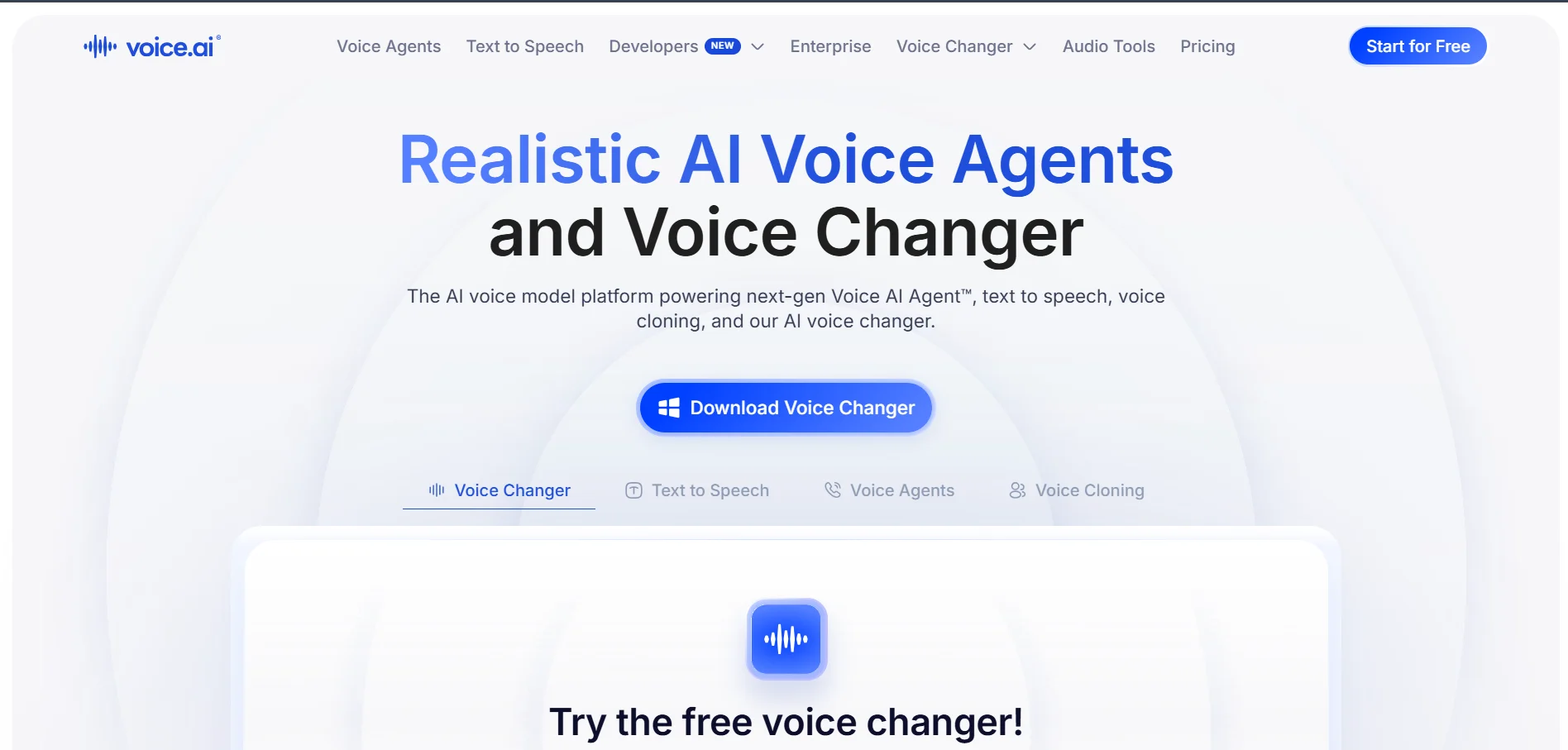
Voice.ai offers a free entry tier alongside Starter at $5/month, which unlocks instant voice cloning and a commercial license with 15,000 monthly credits, per its published pricing breakdown. The Launch plan runs about $12/month for the first month with usage-based billing, while Core reaches $99/month with roughly one million credits for heavier production needs.
Voice.ai leans into real-time voice changing alongside standard text-to-speech, making it popular with streamers, gamers, and content creators who want live voice transformation during calls or streams. Its flexible credit system converts across text-to-speech, voice agents, and audio tools depending on how you use the platform.
Pros
- Real-time voice changing for live streaming and calls
- Affordable Starter tier with instant voice cloning
- Flexible credit system across multiple features
- Usage-based billing on higher tiers
Cons
- Credit conversions can be confusing to calculate
- Entry-level credits run out quickly for regular use
- Introductory Launch pricing rises after the first month
- Less focused on polished, studio-style narration
11. BookFab
Visit Website
Free Trial Available
Lifetime License: $129.99
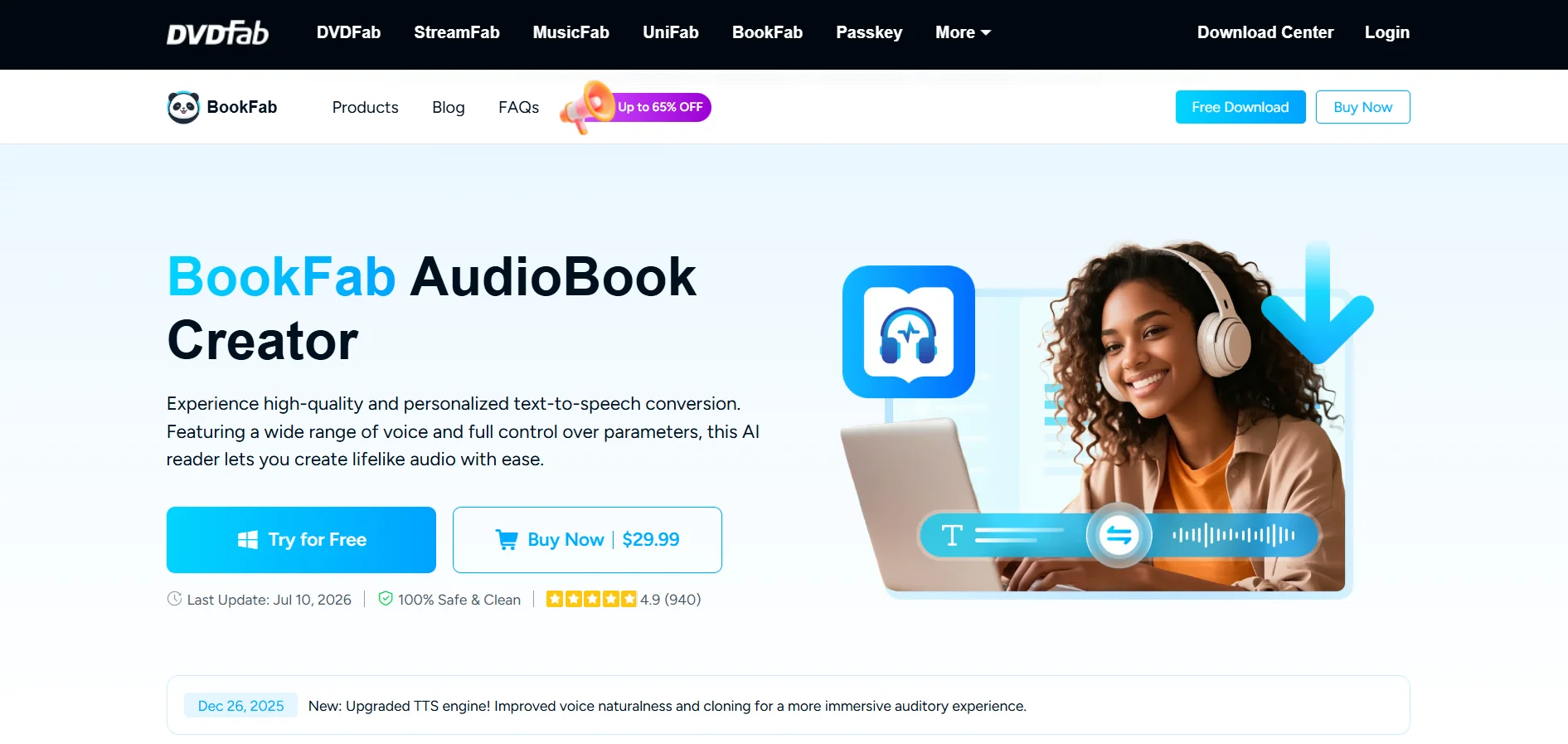
BookFab, DVDFab’s AudioBook Creator, offers a free trial before purchase, with a 1-month license priced at $39.99 according to its official product listings. A Lifetime License costs $129.99 as a one-time purchase, bundling an initial 1,000,000-word quota that covers a full-length audiobook, with additional word packages purchasable separately once used up.
BookFab specializes specifically in converting text and EPUB files into narrated audiobooks, offering over 20 voice presets in English and Japanese with adjustable prosody, expressivity, and pacing controls. It also includes an AI voice cloning feature, making it a niche but focused pick for authors self-publishing audiobooks.
Pros
- Purpose-built specifically for audiobook narration
- Lifetime license avoids recurring subscription costs
- Supports EPUB-to-audiobook conversion directly
- Includes adjustable prosody and pacing controls
Cons
- Windows-only desktop application
- Only supports English and Japanese voices
- Word quota adds ongoing cost once exhausted
- Smaller voice library than dedicated web platforms
12. Lovo.ai
Visit Website

14-Day Free Pro Trial – No Card Required
Basic: $24/mo
Pro: $48/mo
Pro+: $149/mo
Enterprise: Custom
Lovo.ai, marketed under its Genny platform, offers a 14-day free Pro trial with no credit card required, giving roughly 20 minutes of generation to test the service. Official pricing lists Basic at $24/month with 2 hours of voice generation, Pro at $48/month for 5 hours, and Pro+ at $149/month with 20 hours, plus custom Enterprise plans.
Lovo bundles a video editor, AI script writer, subtitle generator, and 500+ voices across 100+ languages into a single creative suite. Its newer Pro V2 directable voices let you shape emotion and accent using natural-language brackets, appealing to marketing teams and e-learning producers wanting an all-in-one workspace.
Pros
- All-in-one voice, video, and script writing suite
- Directable Pro V2 voices with emotion tags
- Voice cloning available from just 1 minute of audio
- Free trial requires no credit card
Cons
- Trustpilot rating has been notably low historically
- Some users report billing and cancellation issues
- Higher tiers get expensive for heavy usage
- Support responsiveness has drawn complaints
Side-by-Side Comparison Table
Conclusion
There’s no single PlayHT alternative, since the right choice depends entirely on what you’re building. If you need polished corporate voiceovers, WellSaid Labs or Murf.AI are strong picks, while creators focused on full video production will likely prefer Fliki or Lovo.ai for their bundled toolsets. Developers building real-time voice applications should look closely at Cartesia, and audiobook authors have a dedicated option in BookFab.
Budget-conscious users experimenting with voice cloning will find Uberduck, KikiVoice, and Supertone Play appealing thanks to their low-cost or free entry points, while Podcastle and Voice.ai round things out for podcasters and streamers respectively. Whichever platform you choose, take advantage of the free trials and free tiers listed above before committing to a paid plan, since voice quality and workflow fit can vary meaningfully from one tool to the next.


